
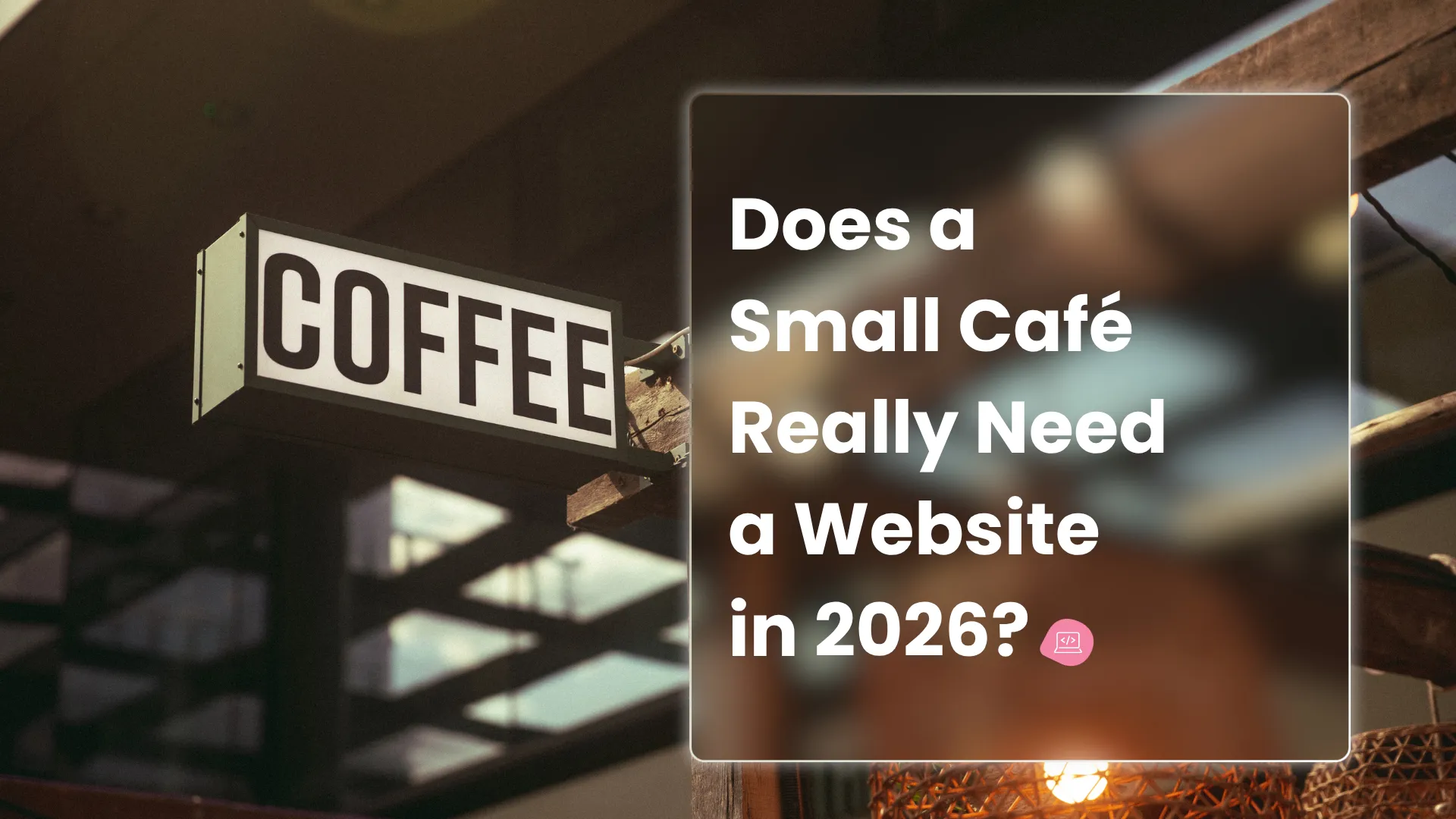
Does a Small Café Really Need a Website in 2026?
Insight
Does a small café need a website in 2026? Discover when Google Maps and Instagram are enough, when a website adds value, and whether it's worth the cost.
Why the right digital presence matters more than having more digital tools.
You run a small café. One location, a handful of staff, good coffee, and regular customers who know exactly what to order.
You already have an Instagram page. Your café appears on Google Maps. Customers leave reviews, tag your business in photos, and occasionally message you to ask about opening hours or today's specials.
So, do you really need a website?
The short answer is no. Not every small café needs one.
But there is a difference between being visible online and making it easy for customers to choose your business.
A website can help bridge that gap. Whether it's worth building depends on how your customers discover you, what information they need, and how they prefer to buy from you.
At RoseRebel, we believe in a simple principle:
A small food business doesn't need more technology. It needs the right digital tools for the way its customers discover, choose, and buy.
Let's explore what that means for independent cafés, bakeries, and small restaurants in 2026.
11. Your Customers Are Already Looking for You Online
Imagine someone walking through a neighbourhood in Melbourne, London, or Dublin and looking for somewhere to have breakfast, grab a flat white, or meet a friend for lunch. They take out their phone and search:
- "Best coffee near me"
- "Brunch café open now"
- "Dog-friendly café in the area"
- "Café with gluten-free options"
Within seconds, they're comparing businesses based on location, photographs, menus, opening hours, and reviews. The decision to visit your café may begin long before someone sees your shopfront.
And recent consumer research supports just how important digital discovery has become.
What the research tells us
In Australia, SevenRooms' 2025 Restaurant Trends Report found that 95% of surveyed consumers used online resources, including Google, social media, and media websites, to discover new restaurants. The same research found that 34% discovered restaurants through Google. The findings came from an online survey of 1,000 Australian consumers conducted between 27 December 2024 and 6 January 2025.
In the United Kingdom, Popmenu's 2026 UK Dining Trends Report, based on a survey of 600 adults conducted between 31 August and 3 September 2026, found that:
- 88% used Google or other search engines to find restaurants.
- 30% used social media for restaurant discovery.
- 60% wanted online menus that were easy to view on mobile devices.
These figures describe how surveyed consumers discover and evaluate restaurants. They don't prove that every individual café needs its own website. Both studies were also published by hospitality technology providers, which is worth considering when interpreting the findings.
Nevertheless, they point to an important distinction: “Customers expect to find useful information online. They don't necessarily care which platform provides it.” For a small café, that distinction can save time, money, and unnecessary investment.
22. Google Maps and Instagram Might Already Be Enough
Here's something website agencies don't always say: “If your existing digital channels already help customers find you, understand what you offer, and visit your café, you may not need a website right now.”
Consider a small takeaway coffee shop near a train station, most customers are commuters. They buy coffee on their way to work, know the menu, and rarely make reservations or place advance orders. The business might already have everything it needs from a well-maintained Google Business Profile and a simple Instagram account.
2.1 Google Business Profile: Your First Digital Priority
For a single-location café, Google Business Profile is often one of the most practical places to begin. It helps people find information about your business through Google Search and Maps, including your address, opening hours, photos, and customer reviews. Google also supports menu links and, where available, links for reservations and food ordering directly from Business Profiles. That means customers may be able to find your café, check the menu, and take the next step without visiting a standalone website.
Google's official Business Profile documentation explains the available business link options. If you haven't claimed, verified, and completed your Google Business Profile, that should usually come before spending money on a new website.
And don't assume that launching a website automatically improves your Google Maps ranking.
According to Google's local ranking guidance, local results depend mainly on relevance, distance, and prominence. A website can support your broader online presence, but it is not a shortcut to a top local ranking.
2.2 Instagram: A Place to Build Interest and Personality
Instagram serves a different purpose. It's where customers discover your atmosphere, see your latest pastries, recognise your team, and get a sense of what makes your café different.
For a highly visual business like a neighbourhood café, that can be valuable. A photograph of a beautifully made cappuccino or your weekend brunch special may do more to communicate your personality than a long description ever could.
But Instagram also has limitations. These problems don't automatically justify a website. But they do suggest something worth investigating: Is your current online presence making customers work harder than they should?
- If the answer is no, you may be better off improving the channels you already have.
- If the answer is yes, it's time to consider what a website could actually solve.
33. Five Signs Your Small Café Might Benefit From a Website
A website becomes worth considering when it solves a specific business problem. Here are five situations in which that investment may begin to make sense.
3.1. Sign 1: Customers Struggle to Find Accurate Information
Your café has a seasonal menu. Opening hours change on public holidays. You offer vegan pastries, but availability varies throughout the week. Some information appears on Google. Other details are posted on Instagram. Your latest menu is hidden in a photograph from three months ago.
Customers have to piece everything together. A simple website can provide one clear, maintained place for important information. Think of it as a central reference that your Google Business Profile, Instagram bio, and other channels can link to. It doesn't need to be elaborate. It just needs to be accurate and easy to use.
3.2. Sign 2: You Regularly Answer the Same Questions
- "Do you take bookings?"
- "Can I see your menu?"
- "Are dogs allowed?"
- "Do you have dairy-free milk?"
- "Do you cater for small events?"
Answering these questions is part of hospitality. But repeatedly answering the same basic enquiries can become a distraction for a small team.
A website can answer common questions before customers need to call or message. That may reduce avoidable enquiries and help staff focus on customers in the café. The benefit here isn't necessarily more sales. It may simply be less friction in everyday operations.
3.3. Sign 3: You Offer More Than Walk-In Coffee
A small café may begin with takeaway coffee and pastries, then gradually introduce other services. Perhaps you now offer birthday cakes, office catering, coffee bean subscriptions, gift cards, or private evening events. These services require more explanation than a typical Google Maps listing can comfortably provide.
A website gives you space to explain your offering, show examples, communicate ordering requirements, and direct customers to the right enquiry or purchasing process. You still don't necessarily need a full e-commerce website. A focused page with a clear enquiry form could be enough.
3.4. Sign 4: Booking or Ordering Is Becoming Important
For a small dine-in café or restaurant, reservations can influence how customers interact with the business. Similarly, a bakery accepting pre-orders may need a more structured ordering process than Instagram messages. This is where a website can become a useful connection point between discovery and purchase.
In Popmenu's 2026 UK consumer study, 49% of respondents said they were more likely to choose a restaurant offering easy online ordering through its own website. The research also found that 63% were less likely to order if they had to use a third-party platform and pay a higher fee. These are reported customer preferences, not evidence that a website will increase revenue by a particular percentage.
For your business, the practical question is whether customers want a simpler way to order or book—and whether your current tools already provide one. A website may help, but integrating an existing booking or ordering service could be more appropriate than building a custom system.
3.5. Sign 5: Your Brand Experience Matters Beyond Your Location
Some cafés compete primarily on convenience. Others attract customers because of their food, interior design, philosophy, or distinctive experience. Think about an independent specialty coffee shop, an artisan bakery, or a brunch destination that people deliberately travel to visit.
Customers may want to understand the story behind the business before they arrive. Instagram can tell part of that story. A thoughtfully designed website can bring the important pieces together in a more structured experience.
This doesn't mean every small café needs an expensive visual identity or custom website. It means that when your brand influences why customers choose you, your digital presence should communicate that value clearly.
44. What Does a Small Café Website Actually Need?
If you decide a website makes sense, start with the smallest version that solves your problem. For a single-location café, that might be a well-designed one-page website. In many cases, the essential content is straightforward.
- An up-to-date menu. Customers should quickly understand what you serve, what items cost, and where to find dietary or allergen information.
- Location and opening hours. Include your full address, a clear directions link, and opening hours that match your Google Business Profile.
- Real photographs. Show the food, drinks, interior, and atmosphere customers can expect. Authenticity is more useful than an elaborate collection of generic images.
- A clear next action. Whether it's "Get Directions", "Book a Table", "Order for Collection", or "Enquire About Catering", make the primary action easy to identify.
- A reason to choose you. A brief introduction can explain what makes your café distinctive without turning your homepage into a lengthy brand presentation.
These basics should work well on mobile, load efficiently, and remain accessible to different users.
The Australian Government's business website guidance recommends defining business goals before choosing technology, prioritising usability, ensuring mobile compatibility, and regularly maintaining website information. There's also an important operational responsibility.
If you publish menus or accept food orders online, allergen information needs careful handling. In the UK, the Food Standards Agency states that food sold online or by telephone must have allergen information provided before the purchase is completed and when it is delivered. In Ireland, the Food Safety Authority of Ireland also sets out requirements for allergen information in distance selling.
A website can help deliver clear information, but it does not replace the business's responsibility to comply with applicable food safety requirements. For a small café, simplicity should never come at the expense of accuracy, usability, or safety.
55. Is a Website Worth the Cost? A Simple Way to Think About ROI
Let's address the question many small business owners care about most: Will a website actually pay for itself?
There's no universal answer. A website doesn't automatically create demand, and every additional visitor to your website is not necessarily an additional customer. Someone who clicks through from Google might already have planned to visit your café. Likewise, a new online order might simply replace an order that would otherwise have arrived through another channel.
The financial value comes from genuinely incremental business, reduced costs, or measurable operational improvements.
5.1. An Illustrative Break-Even Calculation
Suppose a café in the UK invests in a website with an estimated annualised cost of £1,200. That figure is hypothetical, not a market quotation. It represents the café's estimated yearly share of build costs plus relevant ongoing expenses. Now suppose each genuinely additional customer purchase contributes £8 after variable costs.
The calculation becomes: £1,200 ÷ £8 = 150 additional purchases per year.
That's approximately 13 additional purchases per month to cover the assumed annualised website cost. The same framework works in Australia using Australian dollars and the café's own financial figures. This calculation is intentionally simple. It doesn't account for attribution uncertainty, opportunity costs, changes in customer behaviour, or every operational expense.
But it gives the owner a much better starting point than assuming a website is valuable simply because competitors have one.
5.2. Not Every Return Is a New Sale
A website may also create value in less direct ways. For example, if it reduces repetitive enquiries, that may free up staff time. If customers can view catering options without messaging the owner, it may make enquiries more efficient. If a direct ordering system has a different fee structure from third-party platforms, it may change the contribution margin on some orders. These benefits should be evaluated using real figures rather than assumptions.
And remember that a website requires ongoing attention. Domain renewal, hosting, content updates, technical maintenance, security, and any booking or ordering subscriptions should be included in the investment decision. The right question isn't simply, "How much does a website cost?" It's: "What business outcome would make this investment worthwhile?"
66. What Should You Do Before Building a Website?
Before contacting a designer or signing up for a website builder, take a look at your business through a customer's eyes.
- Search for your café on Google using a mobile phone.
- Check what someone sees before they visit your Instagram profile.
- Try to find your menu, locate your opening hours, and complete any booking or ordering process you currently offer.
- Then consider the questions your staff answer most frequently.
You may discover that the priority isn't a website at all.
Perhaps your Google Business Profile needs attention. Maybe your Instagram bio links to an outdated menu. Perhaps customers simply need a better booking link. Fixing these issues first could improve the experience without requiring a new platform. And if the review reveals a clear gap, you'll be better prepared to commission a website with a defined purpose and realistic scope.
A good digital investment starts with understanding the problem—not selecting the technology.
Make the Right Digital Investment for Your Business
At RoseRebel, we approach digital work from the business problem first. Whether you're considering your first website, rethinking your customer journey, or simply trying to understand which digital tools deserve your budget, the starting point should be your customers, operations, and commercial goals.
Not every small business needs a complicated solution. Sometimes the right answer is a better Google profile. Sometimes it's a simple website. And sometimes it's a digital experience designed around a specific growth opportunity.
Let's identify what makes sense for your business.
Start a conversation with RoseRebel
7Sources & Further Reading
Consumer research
- SevenRooms — 2025 Australia Restaurant Trends Report. Published April 2025. Survey of 1,000 Australian consumers, fieldwork December 2024–January 2025. Used for Australian restaurant discovery statistics.
- Popmenu — UK Restaurant Dining Trends to Watch, 2026. Survey of 600 UK adults conducted 31 August–3 September 2026. Used for Google search, mobile menu, and direct ordering preferences.
Search and digital strategy
- Google Business Profile Help — Manage Your Local Business Links. Used to verify the functionality of menu, reservation, and ordering links.
- Google Business Profile Help — Tips to Improve Your Local Ranking. Used to explain local ranking factors and avoid unsupported SEO claims.
- Google Search Central — SEO Starter Guide. Used for search visibility and website SEO principles.
- Australian Government — Set Up a Business Website. Used for guidance on website goals, mobile usability, security, and maintenance.
Food business requirements
- UK Food Standards Agency — Allergen Guidance for Food Businesses. Used for UK food allergen information requirements.
- Food Safety Authority of Ireland — Labelling and Distance Selling. Used for Irish allergen information requirements related to online or remote food sales.
Research note: Survey figures reflect the respondents, markets, and methodologies identified by their publishers. The decision framework and business examples are strategic analysis, not experimental evidence that websites independently cause higher revenue.