White-Label Agency for Website Developement
Insight

Grow your agency, take on bigger projects, and stay focused on clients without hiring a full development team. Let's explore how white-label partnerships make it possible.
Last updated November 12, 2026
Your agency has just landed an exciting website project.
The creative direction is approved. Your designers have a clear vision. The client is ready to move forward.
But there's one challenge: your team doesn't have the development capacity to bring that vision to life.
Hiring developers takes time. Building an internal technical team adds overhead. And turning down the project means leaving a valuable opportunity behind.
For creative agencies, branding studios, and marketing teams, this is a familiar situation.
White-label web development offers another way forward. By partnering with an external development team, agencies can expand their website development capabilities while maintaining control over their brand, client relationships, and creative direction.
This guide explains how the partnership works, when it makes sense, how the commercial models differ, and what to evaluate before choosing a development partner.
1What Is White-Label Web Development?
White-label web development is a service model in which an external development partner builds websites on behalf of another agency, allowing that agency to deliver the work under its own brand.

The agency remains the primary point of contact for its client, while the development partner provides the technical expertise needed to deliver the project.
RoseRebel has worked this way in practice. For an AIA Viet Nam interactive campaign, the team joined AnyMind as an embedded white-label technical partner, providing technical consultation, joining project meetings, developing the platform, and supporting it through launch and maintenance. Read the AIA project story.
For example, imagine a branding agency that specializes in visual identity, strategy, and UX/UI design.
A client approaches the agency for a complete website redesign, including a custom content management system (CMS), interactive elements, and CRM integration.
The agency has the creative capabilities to design the website but lacks the engineering resources to develop it.
Rather than declining the project or hiring a permanent development team, the agency partners with a white-label web development provider.
The agency manages the client relationship and creative direction. The development partner handles the agreed technical implementation. Together, they deliver a complete digital experience.
The key distinction is that the client-facing brand remains the agency's, while the technical work is performed through an external partnership.
White-label arrangements should not be confused with unrestricted secrecy. Confidentiality, subcontractor disclosure, intellectual property ownership, and client communication must still comply with the relevant contracts and legal obligations.
2Why Do Creative Agencies Use White-Label Web Development?
For many agencies, growth doesn't necessarily mean building a larger internal team.
Sometimes, it means expanding what the agency can deliver.
1. Expand Your Services Without Expanding Your Team
A creative agency might excel at brand strategy, visual identity, and digital design without offering full website development.
Yet clients often want more than design files. They want a functional website that brings the creative vision to life.
White-label development allows an agency to introduce complementary services without immediately recruiting software engineers.
A branding studio can extend its offering into corporate websites. A marketing agency can provide campaign landing pages and custom integrations. A UX/UI studio can deliver production-ready digital experiences.
Instead of limiting services to existing internal resources, agencies can build a broader offering through specialist partnerships.
2. Access Technical Expertise When You Need It
Not every website requires the same technical approach.
Some projects are well suited to WordPress or a conventional CMS. Others need a headless architecture, API integrations, custom functionality, or more advanced frontend development.
Maintaining specialists for every technology can be difficult, particularly for smaller agencies.
A development partner can provide additional expertise for specific technical requirements.
This makes it possible to approach more complex projects without assuming the long-term cost of maintaining every capability in-house.
Of course, a partnership is only as strong as the expertise behind it. Agencies should verify a provider's actual experience with the technologies and project types they intend to deliver.
3. Handle Changing Project Demand
Agency workloads rarely remain consistent throughout the year.
One month may involve a handful of small website updates. The next may bring several major website launches with overlapping deadlines.
Permanent hiring is not always the most efficient response to fluctuating demand.
White-label development provides a flexible alternative, allowing agencies to engage technical resources according to project requirements and agreed availability.
This can be particularly useful for agencies that handle seasonal campaigns, project-based creative work, or unpredictable development demand.
4. Keep the Creative Vision Consistent
A successful website isn't simply the result of good design or good code.
It requires both to work together.
The layout, typography, interactions, transitions, and responsive behavior all contribute to the intended brand experience.
For design-led agencies, development quality matters because poor implementation can weaken even the strongest creative concept.
A capable development partner should understand more than technical specifications. They should be able to interpret design intent, identify feasibility constraints, and collaborate on implementation details.
The goal isn't just to make a design functional.
It's to make the finished website feel like the design was always meant to feel.
5. Focus on What Your Agency Does Best
Every hour spent solving unfamiliar technical problems is an hour that could potentially be spent on strategy, client relationships, or creative work.
By working with a development partner, an agency can distribute responsibilities more effectively.
Designers focus on design. Strategists focus on business objectives. Account managers manage relationships. Developers handle technical implementation.
This division of responsibilities works best when expectations are explicit and both teams maintain clear communication throughout the project.
3White-Label Development vs. Freelancers vs. In-House Teams
There is no single best way to build website development capabilities.
The right approach depends on project volume, budget, technical requirements, and the amount of control an agency needs.
| Consideration | In-House Team | Freelancer | White-Label Development Partner |
|---|---|---|---|
| Initial commitment | Recruitment and onboarding | Individual engagement | Partnership setup |
| Ongoing overhead | Salaries and team management | Usually project-based | Depends on engagement |
| Technical coverage | Limited to hired capabilities | Individual specialization | Depends on provider's team |
| Project management | Agency-managed | Often agency-managed | Can be shared or partner-managed |
| Scaling capacity | Requires hiring or reallocation | Requires sourcing more talent | Subject to partner availability |
| Client relationship | Agency-controlled | Defined by agreement | Typically agency-controlled |
| Long-term continuity | Depends on employee retention | Depends on freelancer availability | Depends on provider stability |
In-house development can make sense when an agency has a consistent pipeline of technical work and needs direct operational control.
Freelancers can be effective for clearly defined tasks, specialized deliverables, or occasional development support.
White-label development partners are particularly useful when an agency needs a broader technical delivery capability, structured collaboration, and support across multiple project stages.
The important distinction is that white-label describes how services are delivered and branded. It doesn't automatically guarantee that a provider offers a full development team, formal project management, or ongoing maintenance.
Those capabilities must be evaluated separately.
4What Can a White-Label Web Development Partner Deliver?
White-label development can cover a wide range of digital projects, depending on the partner's technical capabilities.
Corporate and Brand Websites
Custom websites that combine brand storytelling, responsive interfaces, and business functionality.
Typical requirements may include complex page layouts, interactive elements, multilingual content, and performance optimization.
Content Management Systems
A development partner can implement traditional CMS platforms such as WordPress or headless CMS architectures that separate content management from the website frontend.
The right architecture depends on editorial workflows, integrations, performance requirements, long-term maintainability, and budget. RoseRebel's web development and headless CMS services cover both conventional and decoupled approaches.
Custom Web Applications
Some projects require more than a content-driven website.
They may include user accounts, dashboards, application workflows, role-based permissions, or custom backend logic.
These projects require a more detailed technical assessment than a standard marketing website.
API and CRM Integrations
A website may need to exchange data with CRM systems, marketing automation tools, payment providers, or other business applications.
Such integrations should account for data security, reliability, error handling, and ongoing maintenance.
Website Maintenance and Support
A development engagement doesn't necessarily end at launch.
Depending on the agreement, a partner may also provide technical maintenance, troubleshooting, security updates, and further improvements.
For agencies managing long-term client relationships, clearly defined post-launch responsibilities can be as important as the initial build.
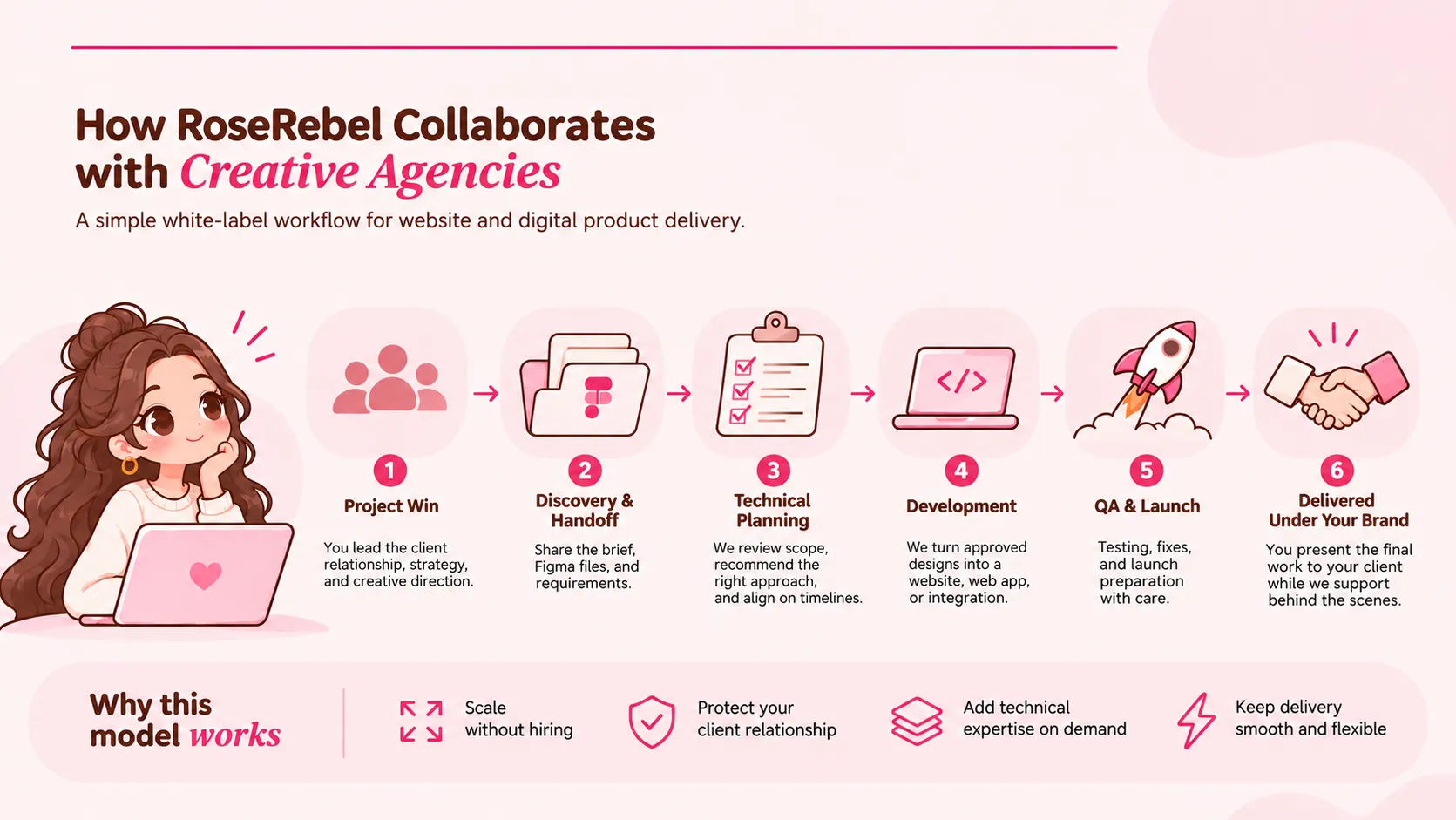
5How Does a White-Label Web Development Partnership Work?
A productive partnership needs more than a good brief and an agreed price.
It needs a delivery process that makes responsibilities, expectations, and decisions clear.
A typical workflow includes six stages.

Step 1: Discovery and Project Scoping
The agency shares the project's business objectives, design requirements, technical expectations, and delivery constraints.
The development partner reviews available materials, identifies gaps, and clarifies any assumptions.
The objective is to establish a shared understanding of what needs to be built.
Step 2: Technical Assessment and Estimation
The technical partner evaluates implementation options and potential risks.
This may include recommending a technology stack, identifying integrations, defining dependencies, and estimating development effort.
A good estimate should communicate what is included, excluded, or dependent on further discovery.
Step 3: Agreement and Kickoff
Before implementation begins, both parties agree on project scope, milestones, communication routines, confidentiality requirements, and acceptance criteria.
They should also clarify who can contact the end client, who owns the source code and deliverables, and how changes will be approved.
Step 4: Development and Collaboration
The development team begins implementation using the approved designs and requirements.
Meanwhile, the agency retains responsibility for its agreed creative and client-facing activities.
Regular progress updates, design reviews, and early identification of blockers help prevent surprises near the launch date.
Step 5: Quality Assurance and Approval
Testing should cover the functionality and quality requirements appropriate to the project.
This may include browser and device compatibility, responsive behavior, accessibility, form submissions, integrations, performance, and security-related checks.
The agency reviews deliverables against the agreed acceptance criteria before approving deployment.
Step 6: Deployment and Handover
The final stage includes deployment, launch verification, and transfer of agreed project assets.
Depending on the engagement, this may include source repositories, documentation, hosting access, CMS credentials, and maintenance instructions.
A well-managed handover helps the agency retain operational control after launch.
6Case Study: An Embedded White-Label Technical Team for AnyMind and AIA Viet Nam

RoseRebel joined AnyMind's delivery team as its white-label technical partner for an interactive campaign platform for AIA Viet Nam. The collaboration began during the idea and planning stages, continued through development and launch, and extended into post-launch maintenance.
The Challenge
The campaign required much more than a conventional landing page. The platform brought together AR games, 3D virtual merchandise, real-time gaming, loyalty points, and reward redemption within one connected experience.
The development timeline was less than eight weeks, creating a demanding combination of technical complexity, system dependencies, and launch pressure.
Working as Part of AnyMind's Internal Team
RoseRebel joined project meetings as part of AnyMind's internal team. During the early stages, the team advised on technical feasibility, implementation options, and the system integrations required to support the campaign concept.
Once the project moved into production, RoseRebel handled website development and system integration using HTML, .NET, and REST APIs. The team built and connected the gaming features, 3D merchandise experience, loyalty functions, and reward mechanics, then supported testing, launch, and ongoing maintenance.
The Outcome for AnyMind
RoseRebel completed the interactive campaign platform in under eight weeks. The finished experience combined the campaign's games, loyalty mechanics, and digital rewards while allowing AnyMind to continue leading the client relationship with AIA Viet Nam.
The partnership gave AnyMind a dependable technical team throughout the project lifecycle. Its team could explore campaign ideas with technical input available from the start, validate the implementation approach early, and move from concept to execution and maintenance with greater confidence.
Read the full AIA interactive campaign case study
Bring a technical team into your next agency project. If you need support with feasibility, project meetings, development, launch, and maintenance, discuss a white-label partnership with RoseRebel.
7How to Choose the Right White-Label Web Development Partner

Choosing a development partner should involve more than comparing hourly rates.
The partner's work will directly affect your agency's delivery quality, client satisfaction, and reputation.
Here are seven areas worth evaluating.
1. Relevant Technical Experience
Ask for examples that resemble the projects your agency wants to deliver.
If you specialize in premium digital experiences, look for evidence of strong frontend implementation and attention to visual detail.
If your clients need business platforms, examine the partner's experience with application architecture, APIs, and data integrations.
Relevant experience matters more than an unusually long list of supported technologies.
2. A Clear Delivery Process
A dependable partner should be able to explain how projects move from discovery to launch.
Ask how they handle requirements, estimates, milestones, approvals, and changes in scope.
A transparent process reduces uncertainty and makes collaboration easier.
3. Quality Assurance Standards
Ask how deliverables are reviewed before they reach your agency.
Do they test across devices and browsers? How are bugs reported and prioritized? How are rejected deliverables corrected?
Quality shouldn't depend entirely on your agency discovering problems during the final review.
4. Communication and Accountability
Even technically strong teams can be difficult to work with if communication is inconsistent.
Agree on a project owner, reporting frequency, communication channels, and escalation process.
For international partnerships, establish overlapping working hours when real-time discussion is necessary.
5. Confidentiality and Intellectual Property
Client confidentiality is central to many white-label arrangements.
Before work starts, clarify whether an NDA is necessary, who owns project deliverables, how confidential information is handled, and whether the development partner may publicly reference the work.
Code ownership, third-party dependencies, pre-existing intellectual property, and portfolio rights should be addressed explicitly.
White-label branding alone does not settle those issues.
6. Transparent Pricing and Change Management
A development estimate is only useful when its assumptions are clear.
Understand what the quote covers, how revisions are managed, and what happens when requirements change.
A slightly lower initial price may not represent better value if essential activities such as testing, deployment, or documentation are excluded.
7. Post-Launch Support
Ask what happens after the website goes live.
Is there a defined warranty or defect-correction period? Who handles urgent issues? Are maintenance services available?
A reliable technical partner should provide clear answers, even when ongoing support is not part of the original contract.
A practical approach is to start with one clearly scoped project before committing to a longer-term partnership.
This creates an opportunity to evaluate technical quality, communication, estimation accuracy, and operational fit using actual delivery experience.
8White-Label Web Development Pricing Models and Agency Margins
White-label web development does not follow a universal pricing structure.
Costs depend on project complexity, technical requirements, team composition, delivery timelines, and the level of support required.
Three common commercial arrangements are:
Fixed-Project Pricing
The development partner charges an agreed amount for a defined scope.
This can work well when requirements, deliverables, and acceptance criteria are sufficiently clear.
Time-and-Materials Pricing
The agency pays for the development effort used, usually based on agreed hourly or daily rates.
This approach may be suitable for projects with evolving requirements, provided there is adequate budget monitoring.
Retainer or Dedicated Development Capacity
The agency reserves a defined amount of technical capacity over a period of time.
This can be useful when there is a recurring pipeline of development requests.
Understanding Your True Project Margin
When evaluating white-label pricing, agencies should account for more than the supplier's development fee.
Consider this hypothetical project:
| Cost or revenue item | Amount |
|---|---|
| Client project fee | $8,000 |
| Development partner | $4,000 |
| Internal project management and QA | $1,000 |
| Third-party costs | $300 |
| Contingency allowance | $500 |
| Estimated project contribution | $2,200 |
| Contribution margin | 27.5% |
Illustrative calculation only. These figures are not market benchmarks, supplier quotes, or RoseRebel Digital pricing.
The example also excludes company-wide overhead, taxes, and other costs that may affect final profitability.
A healthy partnership requires the agency to understand its own delivery economics, not simply add a markup to the supplier's quote.
9Common White-Label Development Risks — and How to Avoid Them
Like any delivery model, white-label development involves trade-offs.
The most common challenges tend to arise from unclear expectations rather than the partnership model itself.
Inconsistent quality: Establish technical standards, review checkpoints, and objective acceptance criteria before development begins.
Missed deadlines: Use realistic schedules, identify critical dependencies, and agree on escalation procedures for delays.
Communication gaps: Assign a clear project owner on each side and document important decisions.
Unexpected costs: Define change requests, revision allowances, and out-of-scope work in advance.
Confidentiality or ownership disputes: Address client information, intellectual property, subcontracting restrictions, and portfolio permissions in written agreements.
None of these measures eliminates risk entirely. However, a disciplined delivery process makes problems easier to identify and resolve.
10When Is White-Label Web Development the Right Choice?
White-label development is worth considering when your agency wants to offer technical services that complement its existing creative or strategic capabilities.
It may be particularly suitable when clients are requesting services beyond your team's expertise, your project pipeline fluctuates, or you want to introduce new capabilities before committing to permanent hiring.
However, it is not always the best approach.
If your agency requires a continuously embedded engineering team, has stable and substantial development demand, or works under contracts that restrict subcontracting, building internal capabilities or using another delivery model may be more appropriate.
The decision should reflect your agency's business model, client expectations, and operational requirements.
The best partnership is one that strengthens your delivery capability without compromising the experience your clients already trust.
11Frequently Asked Questions
What is the difference between white-label web development and outsourcing?
Outsourcing means engaging an external provider to perform work. White-label web development is a specific delivery arrangement in which the agency offers externally developed website services under its own brand. Not every outsourced project is white-label.
Can a white-label development partner build a website from Figma designs?
Yes, provided the partner has the relevant frontend skills and the design files contain sufficient specifications. Before development, both parties should agree on responsive behavior, interactions, animations, reusable components, and any design details that require interpretation.
Who owns the website source code?
Ownership depends on the contract. Agencies should explicitly define rights to custom source code, design assets, documentation, pre-existing components, and third-party libraries. Full ownership should never be assumed solely because the engagement is white-label.
Will a white-label development partner communicate directly with our clients?
That depends on the agreed working model. Some partners operate entirely behind the scenes, while others participate in technical meetings with the agency's permission. Client-facing responsibilities should be established before the project begins.
Is white-label web development cheaper than hiring in-house?
It can reduce the need for permanent hiring and provide flexibility when project demand varies. However, it is not automatically cheaper. Agencies should compare total costs, including project management, quality assurance, coordination, revisions, and long-term support.
How do agencies maintain quality when using a white-label partner?
Agencies can maintain quality through clear specifications, agreed technical standards, scheduled reviews, documented testing, and formal acceptance criteria. Starting with a smaller pilot project can also help evaluate the partner's delivery performance before expanding the relationship.
12Conclusion: Scale Your Services, Not Necessarily Your Team
Growing a creative agency doesn't always require bringing every capability in-house.
Sometimes, the smarter approach is to build the right partnerships.
White-label web development gives agencies another way to expand their services, approach technically demanding projects, and respond to changing client needs while maintaining their own creative direction and client relationships.
The key is choosing a partner who understands both technical delivery and the importance of protecting the agency's brand.
Because the right development partner doesn't replace your agency's identity. They help you deliver on it.
Looking for an Embedded Technical Team for Your Agency?
RoseRebel works alongside creative and marketing agencies as a white-label technical team. We can join project meetings, advise on feasibility, develop websites and custom functionality, and stay involved through launch and maintenance.
Our team brings more than a decade of software development experience and has delivered over 100 digital projects, spanning websites, custom web applications, content management systems, and technical integrations.
Bring us in when your agency needs technical depth without building a permanent engineering team for every project.
Discuss a white-label partnership | Review our work
About the author: RoseRebel Digital is a Vietnam-based boutique digital studio combining strategy, design, and engineering to build websites, applications, and digital platforms.